
Introduction
Thank you for your interest in the Recognition of Prior Learning (RPL) program for Hospitality Industry professionals and educators. RPL is one of the most up-to-date industry-relevant recognition programs available.
The Institute of Tourism Studies recognises that prospective students gain knowledge, skills, and competencies in various settings, through formal education and training, workplace experience, or general life experience.
What is RPL?
Recognition of prior learning (RPL) is how students can gain exemption to or credit within a nationally recognised qualification course/s based on learning outcomes of the study unit for which the candidates applied. These include competencies gained through formal, non-formal and informal learning.
The two most common methods for gaining skills recognition are:
Credit Transfer (CT)
Credit Transfer assesses the course, subject or unit of competence an individual is claiming exemption or the award of credit in the destination course to determine the extent to which it is equivalent to the required learning outcomes, competency outcomes, or standards in a qualification.
Units to be considered for credit transfer must compare heavily in content, objectives and standard to equivalent units in the Institute course.
Recognition of Prior Learning (RPL)
RPL is a form of assessment that recognises a person's skills, knowledge and competencies acquired through previous personal development training, education, work and general life experience. The benefits of RPL may reduce the time a student has to spend attending classes or relearning what they already know and have achieved through life and experience, and knowledge.
Course documentation the prospective student provides must be authentic (for example, something prepared, produced or written about them by a relevant third party) and must be sufficient to demonstrate competence against the unit/s of competence.
The applicant must also demonstrate that this evidence is still current and relevant through various means such as a portfolio, interviews, voluntary work, written answers, assignment, case studies or a practical demonstration.
ITS may use evidence of skills and knowledge to grant credits or exemption for a subject, module, course or qualification.
The Recognition for Prior Learning Flow Chart
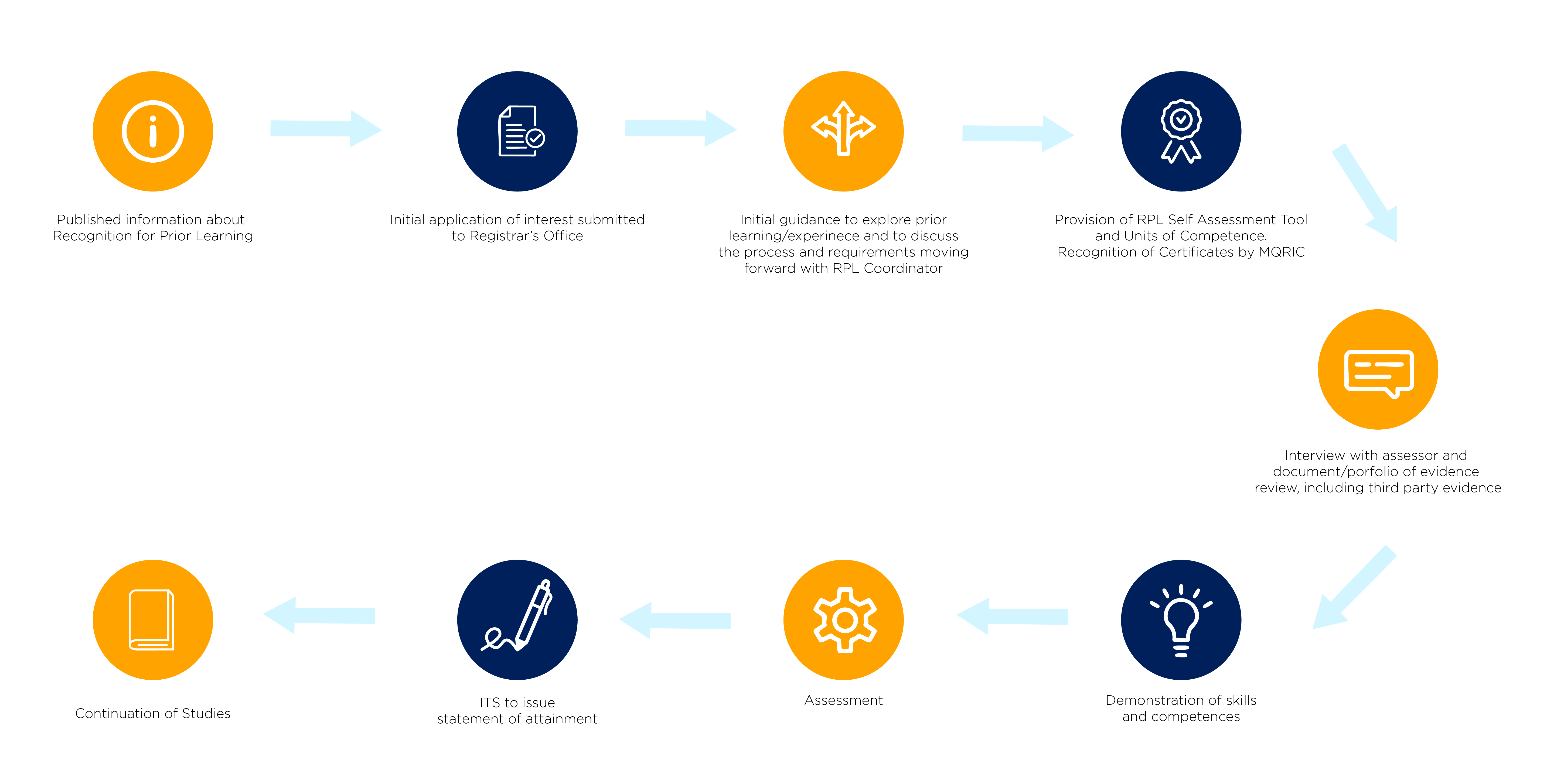
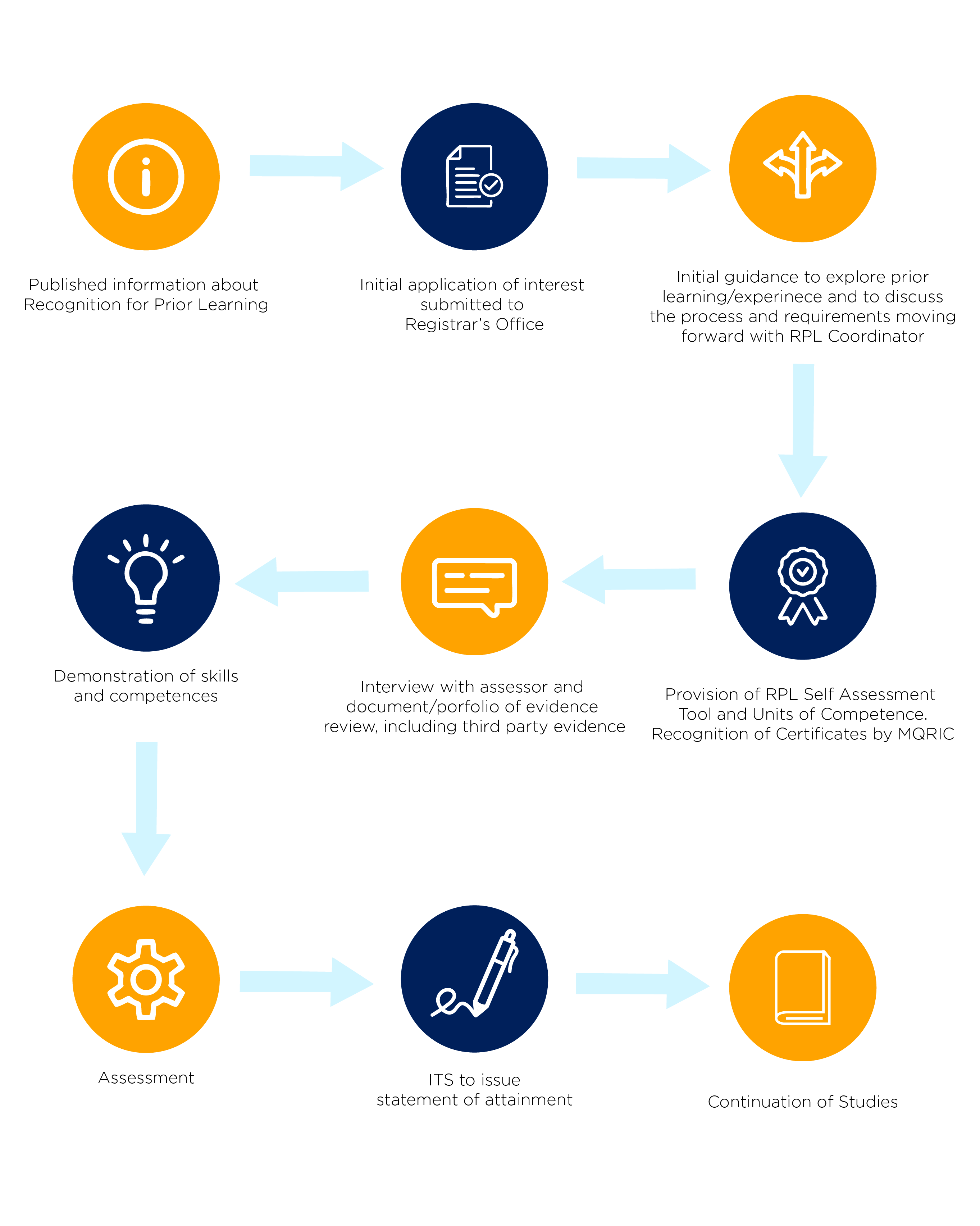



Against what will the candidate be assessed?
The candidate will be assessed against the comparable course syllabus, which will clearly state the knowledge, skills and competence needed for the particular study unit for which the candidate is applying.
ITS may include work experience, informal and non-formal training and education and personal development, voluntary work, and life experience.
Prior to RPL Application
Before applying for a course, the student candidate is encouraged to make a self-assessment to confirm that their skills are comparable to the ITS course offering. The process begins by reviewing the relevant course modules associated with your RPL. For more details on the course descriptions and the MQF level, consult the list of modules.
The applicant is also advised to make a self-assessment for the concepts stated below:
Authenticity
- Is the evidence your work?
- Are the qualifications, references and licences presented by authentic documents?
Relevance
- Does the evidence show that you can perform the competence while working?
- Does the evidence demonstrate that through professional development, experience or continued employment, that your skills and knowledge are current?
Sufficient
- Does the evidence cover the full range of performance identified in the unit of competency?
- Does the evidence show competence over some time?
- Does the evidence show competence in a range of contexts?
Validity
- Does the evidence relate to a unit of competence?
- Does the evidence reflect the four dimensions of competency?
- Does the evidence address the key competencies?
Applying for RPL
Candidates interested in applying for RPL will be required to return or upload their application form, along with scanned copies of identification documents such as your National Identity Card or Passport and an official Job Employment History to rpl@its.edu.mt.
If you have questions about completing your application, please email the recognition for prior learning's office of The Institute of Tourism Studies for further clarification and guidance.
Applications for RPL must be submitted before enrolment for a course, ideally at least 28 working days before the beginning of classes.
There are two stages in the Recognition for Prior Learning process. The first stage is to seek guidance from The Institute of Tourism Studies RPL coordinator via email once the candidate formally applies for RPL.
Download the RPL Application FormCandidates must identify the course, study unit, or competencies for prior learning through which the candidate wishes to be assessed on the application form. A maximum of 50% of the total European Credit Transfer System (ECTS) or European Credit Vocational Educational Training (ECVET) from a whole course program or unit may be eligible for credit transfer of the RPL.
Example 1:
If a whole course totals 60 ECTS's, students can transfer a maximum of 30 ECTS's from Recognition for Prior Learning.
Candidates who have obtained an exemption through formal qualification will count toward the maximum credits that a candidate may achieve from Exemption and RPL.
Example 2:
If a complete course is made of 60 ECTS's and 10 ECTS credits have been awarded through exemption, only 20 ECTS can be transferred from Recognition for Prior Learning, which can be a maximum combined total of 50% credits from a course.
Preparing Evidence
The process of gathering, certifying and uploading evidence of your RPL application is essential to understand. Evidence allows the Assessor/s to make an informed judgment of your ability to fulfil the requirements of the learning outcomes, skills or competencies. The more evidence you can provide of your skills, knowledge, and competencies, the easier it is for an assessor to make a determination.
The candidate must prepare a portfolio of evidence to support their work experience of non-formal and informal knowledge. Your objective is to establish the best case for RPL as possible. Therefore the amount and strength of your evidence are essential when making a strong case for RPL.
Assessment Process
The assessment process will evaluate the candidate's non-formal and informal learning. Still, ITS may also use other forms of assessment such as interviews, assignments, case studies or practical assessment to validate the RPL assessment and to ensure that the candidate has the required skills, knowledge and competence of the study unit for which the candidate is applying.
The candidate will be notified of any overarching assessments and/or staged inspections by the RPL coordinator so that the applicant can make the necessary arrangements. The assessor/s may reserve the right to ask for practical technical evidence at any time of the Recognition of Prior Learning if furthermore substantial evidence may be needed.
RPL Fees
RPL fees (currently €25 per ECTS) is charged to all students, whether paying or not, with the proviso that non-paying students who are successful in their RPL exercise are refunded the RPL fee while paying students are refunded tuition fees, as per current practice.
The final fee of the RPL shall be based on the number of the total credits allocated per study unit. (e.g. if the study unit has 6 credits - ECTS / ECVETS - allocated to it a fee of €150.00 should be charged prior to the assessment process).
The same fee of €25.00 per ECVET/ECTS credit will be APPLIED for all at EQF/ MQF Level 7 recognition of prior learning (RPL) assessments.
Students who are paying for their courses (i.e. non-EU or part-time) need to pay RPL as per established fees. If they are given the exemption of that particular module through RPL then they will be deducted from the tuition fees.
Example:
Mr Johnson is a paying student from USA which does not form part of the EU. He is to pay for the course fees that he is to enrol in. He then asks for recognition of prior learning (RPL) for module XYZ001 which falls within the course of studies that he has enrol in.
If Mr Johnson succeeds and an exemption through RPL is granted, he is to pay for the RPL assessment per credit as stipulated in 3.1 for the module he has applied and found to be successful in, but the amount paid will be deducted from his study course fees. This is done so students do not have pay a double fee for the same module while at the same time encouraging them to take RPL if they feel they can make it.
Feedback/Decisions
Once the assessors and technical experts have reviewed the application, the RPL coordinator shall submit a detailed report to the registrar's office. A copy will be sent to the Institute's Internal Quality Assurance Committee (IQAC) by email at qualityassurance@its.edu.mt.
Applicants whose RPL claim is denied through their assessment will be informed of the knowledge, skills or competencies that are not comparable and shall be given the opportunity to either:
- Re-take the RPL assessment when the candidate thinks that the missing learning outcomes/elements have been completed.
OR
- Follow a study unit or parts of it on a part-time basis to make up for the identified knowledge, skill or competence for a nominal fee.
Right of Appeal
Applicants who conclude the RPL assessment did not adequately take their skills and competencies into account may forward a written complaint to the RPL coordinator via rpl@its.edu.mt and CC the Institute of Tourism Studies Internal Quality Assurance Committee (IQAC) at qualityassurance@its.edu.mt.
The RPL coordinator shall appoint different assessors and technical academic experts to re-assess the RPL claim if a formal complaint that the applicant was unfairly assessed is filed. The results of the reconsidered assessment are final, and ITS shall provide feedback to the candidate/applicant in the form of a detailed written report.